
Rideshare accidents feel confusing because insurance coverage changes based on the driver’s app status at the exact moment of the crash.
If you’ve ever been in a collision involving an app-based driver, you probably walked away thinking: “Wait… whose insurance is this?” That reaction is normal.
A rideshare crash blends personal driving, commercial activity, and a company platform. In Georgia, those factors determine which insurance policy applies, how much coverage is available, and who pays first.
Georgia’s rideshare insurance framework is governed by O.C.G.A. § 33-1-24, which explains how coverage changes depending on whether a driver is offline, waiting for a request, or actively transporting a passenger. The statute is published by Justia.
This is why rideshare accident cases feel so confusing—and why many injured people speak with a rideshare accident lawyer in Atlanta to understand their rights and next steps, especially when injuries or multiple vehicles are involved.
Quick Answer – Why Are Rideshare Accidents So Complicated?
Rideshare accidents are complicated because:
- insurance coverage depends on app status,
- multiple insurance policies may apply, and
- key evidence is controlled by the rideshare company.
Below are the most common reasons rideshare accident cases in Georgia feel messy and frustrating.
7 Reasons Rideshare Wrecks Feel Confusing
1. Insurance “Switches” Based on App Status
Georgia’s TNC insurance law ties coverage to whether the driver was logged into the network, waiting for a request, en route to a rider, or actively transporting a passenger.
Because of this structure, the primary insurance policy can change instantly, as outlined in Georgia’s rideshare insurance statute.
2. There Can Be Multiple Responsible Parties
In many rideshare accident cases, there may be:
- the rideshare driver,
- another at-fault driver, and
- multiple insurance policies disputing which one pays first.
This layered structure is why many injured people turn to Accident Professionals to get connected with rideshare accident attorneys experienced in multi-policy disputes.
3. “Commercial Use” Can Trigger Coverage Disputes
Georgia law requires specific insurance coverage when a driver is providing rideshare services and anticipates disputes over which policy is primary.
These disputes are directly addressed in O.C.G.A. § 33-1-24 and are a common reason rideshare claims stall
4. Evidence Lives Inside an App You Don’t Control
Trip logs, timestamps, and app-status data often determine which insurance tier applies.
Because injured people do not control this data, many consult rideshare accident attorneys early so steps can be taken to preserve app-based evidence.
5. Reporting Rules Still Apply, Even When You Weren’t the Driver
Georgia law requires immediate notice to law enforcement when a crash involves injury, death, or apparent property damage of $500 or more, as explained in O.C.G.A. § 40-6-273.
The Georgia Department of Driver Services also advises contacting police as soon as possible after a crash.
6. Fault Rules Can Reduce (or Bar) Recovery
Georgia uses a comparative fault system. Damages may be reduced—or barred entirely—depending on fault percentages, as outlined in O.C.G.A. § 51-12-33.
This becomes especially important in rideshare accidents involving multiple vehicles.
7. Strict Deadlines Apply
Most Georgia personal injury claims must be filed within two years, under O.C.G.A. § 9-3-33.
Waiting too long can result in lost evidence and forfeited rights.
Georgia’s rideshare insurance system is built around specific app-status time periods, not just fault.
Georgia’s TNC statute is built around time periods tied to the driver’s connection to the rideshare company’s digital network. (Justia) That’s why two crashes that look identical on the street can be handled very differently by insurance.
Think of rideshare services like a light switch with three positions (and yes, this applies to most major rideshare services):
Phase 1 — App OFF (Personal Driving)
If the driver is not logged in, the crash typically follows standard auto insurance rules. Injured people may still benefit from guidance through Atlanta accident resources from Accident Professionals.
Phase 2 — App ON, Waiting for a Request
When a driver is logged in and available, Georgia law requires minimum coverage of:
- $50,000 bodily injury per person
- $100,000 bodily injury per incident
- $25,000 property damage
Phase 3 — App ON + Trip in Progress
Once a ride is accepted or a passenger is being transported, Georgia requires at least $1,000,000 in coverage, making these cases significantly higher value and more complex.
Real-World Example in Plain English
Imagine you’re rear-ended in Midtown Atlanta.
If it’s a regular driver, you exchange information and file a claim. If it’s a rideshare vehicle, coverage depends on whether the driver was offline, waiting for a request, or actively transporting a passenger.
That single detail—what was happening in the app—can change everything.
1. Call Law Enforcement and Document the Scene
Georgia law requires reporting qualifying crashes immediately. Take photos of vehicle positions, damage, plates, road conditions, and visible injuries when safe.
2. Get Rideshare Details Before the Vehicle Leaves
- Police report or incident number
- Photos or video of the scene
- Witness contact information
- Screenshots showing ride status or trip receipts
- Medical records and bills
Collecting this evidence early helps prevent insurance disputes and delays.
3. Seek Medical Care and Keep Records
Medical records connect your injuries to the crash and help document damages.
4. Request Your Crash Report the Right Way
Crash reports are available through the Georgia Department of Transportation crash reporting system.
If the Georgia State Patrol investigated the crash, requests are handled through the Georgia Department of Public Safety Open Records process.
Get Help After a Rideshare Accident in Atlanta
If you’re already feeling the “too many policies, too many adjusters” confusion, this is where Accident Professionals can help by connecting you with rideshare accident attorneys who understand Georgia’s coverage rules.

What to Collect for Rideshare Accident Cases (The Evidence Stack)
- Police report or incident number
- Photos and video
- Witness contact information
- App screenshots or trip receipts
- Medical records and bills
- Messages exchanged in the app
Collecting this early helps prevent insurance delays.
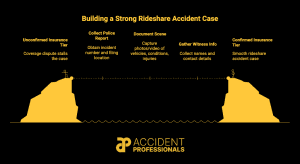
What Makes These Claims Harder — The Coverage Priority Fight
Georgia law anticipates disputes over which insurance policy is primary. Insurers often delay while confirming app status, which is why rideshare accident cases can feel especially frustrating.
Georgia Deadlines You Should Know
- Duty to notify law enforcement immediately in qualifying crashes: O.C.G.A. § 40-6-273 (Justia)
- Personal injury lawsuit deadline (generally): two years from when the claim accrues: O.C.G.A. § 9-3-33 (Justia)
- Fault can reduce or bar damages depending on percentage: O.C.G.A. § 51-12-33 (Justia)
Because of these deadlines, many people talk with a rideshare lawyer sooner rather than later.
How Accident Professionals Helps
Accident Professionals connects people in Atlanta with rideshare accident attorneys who understand Georgia’s TNC insurance framework and know how to protect evidence and push back on coverage disputes.
If your crash involved a rideshare vehicle, don’t let insurance confusion derail your recovery.
Contact Accident Professionals to get connected with a rideshare accident lawyer in Atlanta today.
Frequently Asked Questions
Do I need a rideshare accident lawyer if I was a passenger?
Often, yes—especially if injuries are more than minor or multiple vehicles are involved.
What if I was hit by a rideshare driver who wasn’t carrying a passenger?
Coverage still depends on whether the driver was logged in and available.
Can I still recover if I was partly at fault?
Possibly. Georgia law may reduce damages based on fault.