
Feeling fine after a car accident does not mean you are uninjured.
After a crash in Atlanta, many people walk away believing they are “okay.” Adrenaline fades, insurance information is exchanged, and life continues. But under Georgia public health guidance and legal standards, symptoms may not appear immediately.
This article explains:
- Why delayed injuries are medically recognized
- How Georgia law treats crash documentation
- Why early medical records matter in a car accident claim
- How insurers evaluate treatment timelines
If you are unsure how medical documentation affects your rights, a car accident lawyer in Atlanta can explain how claims are evaluated under Georgia law.
Do You Need to See a Doctor After a Car Accident If You Feel Fine?
Yes. Georgia public health authorities recognize that symptoms may be delayed after traumatic events, and early medical evaluation helps:
- Identify hidden injuries
- Create documented timelines
- Reduce insurance disputes
- Protect legal rights
Even when pain is not immediate, documentation matters.
How Adrenaline Can Hide Car Accident Injuries
The Georgia Department of Public Health explains that traumatic events trigger stress hormones that can temporarily suppress pain signals.
This means symptoms may not appear for hours—or even days—after a collision. Delayed symptom presentation is medically recognized. It is not uncommon.
What Georgia Law Says About Crash Reporting and Injuries
Georgia law requires that crashes involving injury be reported to law enforcement immediately or as soon as possible under O.C.G.A. § 40-6-273.
Law enforcement reports typically document whether injuries were observable at the scene—not whether injuries ultimately exist.
From a legal standpoint, that distinction matters.
A car accident attorney often relies on:
- Emergency room records
- Urgent care evaluations
- Primary care visits
- Diagnostic imaging
These records establish a timeline between the crash and symptom onset, which insurers carefully examine.
What Injuries Often Appear Days After a Car Accident?
Georgia public health and trauma care authorities, including the Georgia Trauma Care Network Commission, recognize that certain injuries may present later, including:
- Soft tissue injuries
- Concussions
- Cervical strain (whiplash)
- Lumbar strain
- Internal inflammation
Post-incident screening is commonly emphasized after traumatic force events such as vehicle collisions.
Why Insurance Companies Question Delayed Medical Treatment
Insurance carriers evaluate:
- How soon care was sought
- Whether symptoms were documented early
- Consistency between crash reports and medical records
Delays in treatment are often cited by insurers to dispute causation, arguing that injuries were unrelated or pre-existing.
Georgia follows a modified comparative fault system under O.C.G.A. § 51-12-33. Disputes over causation can directly affect compensation eligibility.
This is one reason many injured individuals consult Accident Professionals to connect with attorneys who understand how medical timelines impact injury claims.
How Medical Records Affect a Georgia Car Accident Claim
Under O.C.G.A. § 9-3-33, most Georgia personal injury claims must be filed within two years of the date of injury.
However, filing deadlines do not replace the need for credible documentation.
Medical records help establish:
- Injury existence
- Injury severity
- Causation (connection to the crash)
- Necessity of treatment
A car accident lawyer does not provide medical care but relies on licensed providers’ documentation when evaluating claims.
Why Early Medical Evaluation Matters
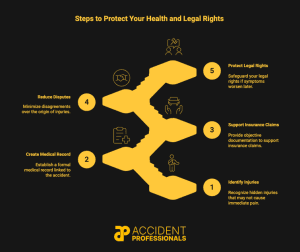
After a car accident in Atlanta, early medical evaluation helps:
- Identify injuries that may not cause immediate pain
- Create a formal medical record tied to the collision
- Support insurance claims with objective documentation
- Reduce disputes about injury origin
- Protect legal rights if symptoms worsen later
This is about documentation and clarity—not assuming injury.
What Happens If You Wait Too Long to Seek Treatment?
Waiting too long can:
- Weaken causation arguments
- Create gaps insurers may exploit
- Reduce claim credibility
- Complicate settlement negotiations
Courts and insurers rely on documentation—not assumptions. Early evaluation preserves clarity if symptoms worsen later.
Atlanta Crash Trends and Delayed Injury Risk
Atlanta’s traffic density increases the likelihood of rear-end and multi-vehicle crashes. According to the Georgia Department of Transportation crash data reports, rear-impact collisions are among the most common statewide.
Rear-end crashes are frequently associated with delayed musculoskeletal symptoms, reinforcing the importance of post-accident medical screening.
If you were injured in an Atlanta crash, you can explore your options through Accident Professionals.
If you were involved in a crash in Atlanta and are unsure how medical documentation affects your rights, Accident Professionals can connect you with a car accident attorney who can explain how medical timelines and documentation are evaluated under Georgia law.
You can submit a form online or call to learn more.

What Georgia agencies do not recommend
It is important to clarify:
- Georgia agencies do not advise self-diagnosis
- They do not guarantee that every crash causes injury
- They emphasize evaluation, not assumptions, after traumatic events
This article does not provide medical advice. It reflects Georgia public health and legal documentation standards only.
When People Regret Not Seeing a Doctor After a Crash
Individuals often reconsider early medical evaluation when:
- Pain develops days later
- Insurance requests medical proof
- Symptoms interfere with work
- A claim becomes disputed
Early documentation can prevent unnecessary complications.
Final Takeaway: Protect Your Health and Your Claim
Seeing a doctor after a car accident—even when you feel fine—is not about assuming injury. It is about:
- Following Georgia public health guidance
- Protecting accurate documentation
- Preserving clarity if symptoms evolve
If you were involved in a collision in Atlanta and want to understand how medical records intersect with Georgia injury claims, Accident Professionals can help connect you with a car accident lawyer who can explain your options.